Part 1: Core Concepts and Fundamentals
This page explains the fundamental concepts you need to understand before diving into the code. We'll cover what IPC is, why it exists, and how the producer-consumer problem is solved using shared memory and semaphores. Take your time with each section—these concepts are the foundation for everything that follows.
Note: The
full
working implementation is available in the code folder. This website focuses on
explaining the concepts clearly so you can understand the code when you read it.
1.1 What is Inter-Process Communication (IPC)?
The Problem: Process Isolation
When you run a program on your computer, the operating system creates a process—an isolated running instance of that program. Each process has its own private memory space, which means:
- Variables in one process are invisible to other processes
- One process cannot directly read or write another process's data
- Each process lives in its own "sandbox" protected by the operating system
Why is this a problem? Many real-world applications need multiple processes to work together. For example:
- A web browser (process A) needs to tell a download manager (process B) to fetch a file
- A database server needs to share query results with multiple client applications
- A sensor monitoring system needs to send readings to a display dashboard
The Solution: Inter-Process Communication (IPC)
IPC (Inter-Process Communication) is a set of mechanisms provided by the operating system that allows separate processes to share data and coordinate their actions. Think of IPC as a "communication bridge" that the OS builds between isolated processes.
Key difference from threads: If you've used multi-threading, you know that threads within the same process share memory automatically. IPC is different—it's for communication between completely separate processes that don't share memory by default.
Key IPC Mechanisms in System V:
System V is a family of Unix operating systems, and "System V IPC" refers to the specific IPC mechanisms it introduced. These mechanisms are now available on virtually all Unix-like systems, including Linux and macOS. The three main mechanisms are:
- Shared Memory — Multiple processes map the same region of physical memory into their address spaces. When one process writes to this memory, other processes can immediately read the change. This is the fastest form of IPC because data doesn't need to be copied.
- Semaphores — Kernel-managed integer counters used for synchronization and coordination. They help prevent race conditions (two processes modifying data at the same time) and allow processes to signal each other.
- Message Queues — Processes can send structured messages to a queue, and other processes can read them. (This mechanism is not covered in this tutorial, but follows similar patterns.)
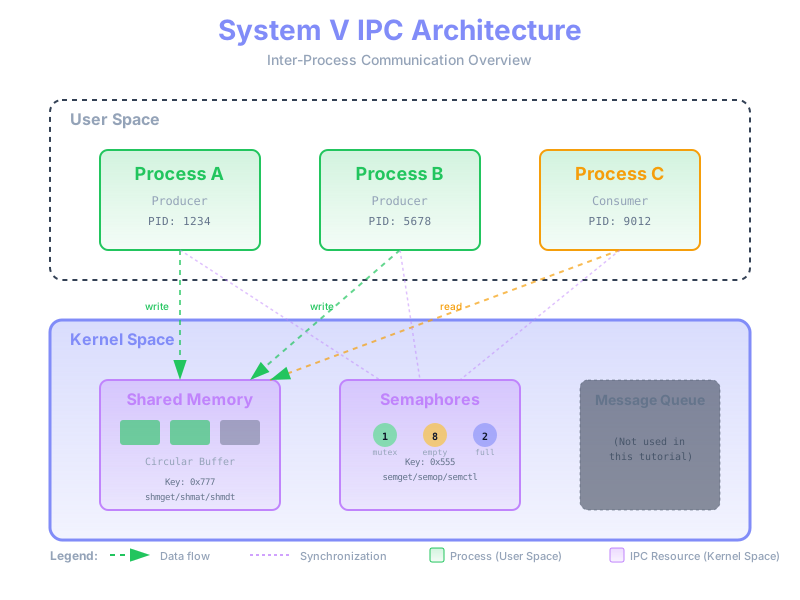
System V IPC architecture showing process separation and kernel-managed IPC resources
Why the Kernel Manages IPC Resources
You might wonder: why does the operating system kernel need to be involved? The answer is persistence and access control:
- Persistence: IPC resources (like shared memory segments) can outlive the processes that create them. If Process A creates shared memory and then exits, Process B can still access it later. The kernel keeps these resources alive.
- Access Control: The kernel enforces permissions (like file permissions) on IPC resources, ensuring only authorized processes can access them.
- Coordination: The kernel handles the low-level details of making memory visible to multiple processes and managing semaphore operations atomically.
1.2 The Producer-Consumer Problem
What Is This Problem?
The Producer-Consumer Problem (also called the Bounded-Buffer Problem) is one of the most fundamental synchronization problems in computer science. It was first described by Edsger Dijkstra in 1965 and appears everywhere in real systems.
The setup is simple:
- Producers are processes that generate data items and place them into a shared buffer
- Consumers are processes that remove items from the buffer and process them
- The buffer has a fixed size (it's "bounded"—it can only hold N items at a time)
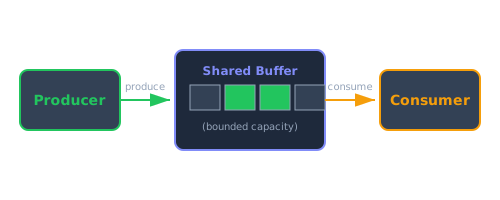
Basic producer-consumer flow showing bounded buffer between producer and consumer
Why Is This a "Problem"?
The challenge isn't just passing data—it's doing so correctly under all conditions. Consider what can go wrong:
Constraint 1: What if the buffer is full?
If the producer generates data faster than the consumer can process it, the buffer fills up. A producer must wait until space becomes available—otherwise it would overwrite data the consumer hasn't read yet, causing data loss.
Constraint 2: What if the buffer is empty?
If the consumer is faster than the producer, it might try to read from an empty buffer. A consumer must wait until data arrives—otherwise it would read garbage or crash.
Constraint 3: What if both access the buffer simultaneously?
If a producer is writing to slot 5 at the exact moment a consumer is reading from slot 5, you get a race condition. The consumer might read partially-written data, causing corruption. Only one process should access the buffer at a time (this is called mutual exclusion).
Real-World Analogy: The Conveyor Belt
Imagine a conveyor belt at a factory with exactly 10 slots:
- Factory workers (producers) place items on the belt
- A packer (consumer) takes items off the belt and boxes them
- If all 10 slots are full, workers must wait for the packer to clear a slot
- If the belt is empty, the packer must wait for workers to produce something
- Only one person can touch a specific slot at any moment
This physical constraint naturally enforces the three rules above. In software, we need semaphores to enforce them.
Why This Problem Matters
The producer-consumer pattern appears everywhere in computing:
- Keyboard input: The keyboard driver (producer) puts keystrokes in a buffer; your text editor (consumer) reads them
- Network packets: The network card (producer) fills a buffer with incoming data; your application (consumer) processes it
- Print spoolers: Applications (producers) queue print jobs; the printer driver (consumer) sends them to the printer
- Video streaming: The decoder (producer) fills a frame buffer; the display system (consumer) renders frames
Mastering this pattern gives you a foundation for understanding most concurrent systems.
1.3 The Three-Semaphore Solution
What Is a Semaphore?
Before diving into the solution, let's understand what a semaphore is. A semaphore is a special integer variable managed by the operating system kernel that supports two atomic operations:
- P (wait/decrement): Try to subtract 1 from the semaphore. If the value is already 0, the process blocks (goes to sleep) until the value becomes positive.
- V (signal/increment): Add 1 to the semaphore. If any processes are blocked waiting, one of them is woken up.
Key insight: These operations are atomic—they cannot be interrupted halfway. This guarantees that two processes calling P() simultaneously won't both succeed when only one "resource" is available.
(The letters P and V come from Dutch words: "Proberen" = to test, "Verhogen" = to increment. They were named by Dijkstra, who was Dutch.)
To solve the producer-consumer problem correctly, we use three semaphores:
1.3.1 Why Three Semaphores Are Necessary
You might wonder: why can't we just use a single mutex semaphore to protect the buffer? Let's think through this:
If we only used a mutex (a simple lock):
- ✓ We could prevent simultaneous access to the buffer (solving the race condition)
- ✗ But we couldn't tell when the buffer is full or empty
- ✗ Producers would need to busy-wait: constantly acquire the lock, check if space is available, release the lock, repeat. This wastes enormous CPU time!
- ✗ Consumers would similarly busy-wait checking for available items
What is busy-waiting? Imagine you're waiting for a friend at a cafe. Busy-waiting is like calling them every second: "Are you here yet? Are you here yet?" Instead, you could just sit down and let them tap you on the shoulder when they arrive. Semaphores provide that "tap on the shoulder" mechanism.
The three-semaphore solution eliminates busy-waiting:
mutex— Provides mutual exclusion (only one process modifies buffer at a time)empty— Counts available empty slots (producers wait when this hits 0, meaning buffer is full)full— Counts available items (consumers wait when this hits 0, meaning buffer is empty)
This allows processes to block efficiently—they go to sleep and the OS wakes them up only when conditions change, instead of wasting CPU cycles polling.
1.3.2 The Semaphores Explained
| Semaphore | Type | Initial Value | Purpose |
|---|---|---|---|
mutex |
Binary (0 or 1) | 1 | Ensures only one process accesses buffer indices at a time |
empty |
Counting | buffer_size | Counts available empty slots in the buffer |
full |
Counting | 0 | Counts filled slots ready for consumption |
Understanding the Initial Values:
- mutex = 1: The "lock" starts unlocked. Value 1 means "available," value 0 means "taken."
- empty = buffer_size: Initially, ALL slots are empty. If buffer_size is 8, we start with 8 empty slots.
- full = 0: Initially, NO items are available for consumption.
Semaphore Operations Explained:
- P (wait/decrement): Attempts to decrement the semaphore. If the value is 0, the process blocks until it becomes positive. Think of it as "taking a resource."
- V (signal/increment): Increments the semaphore. If processes are waiting, one is unblocked. Think of it as "returning a resource."
Producer Algorithm (Step by Step):
while (true) {
    produce_item()     // Generate the data (outside critical section)
    P(empty)           // Wait for an empty slot (blocks if buffer full)
    P(mutex)           // Enter critical section (get exclusive access)
    place_item_in_buffer()  // Write to buffer (protected)
    V(mutex)           // Exit critical section (release lock)
    V(full)            // Signal that a product is now available
}
What happens at each step:
- produce_item(): Generate data (this can take time, so we do it BEFORE acquiring any locks)
- P(empty): Decrement
emptycount. If buffer is full (empty=0), block until consumer frees a slot. - P(mutex): Acquire exclusive access to the buffer. If another process has it, wait.
- place_item_in_buffer(): Safely write to the buffer (we have exclusive access).
- V(mutex): Release the lock so others can access the buffer.
- V(full): Increment
fullcount, potentially waking a waiting consumer.
Consumer Algorithm (Step by Step):
while (true) {
    P(full)            // Wait for a product (blocks if buffer empty)
    P(mutex)           // Enter critical section
    remove_item_from_buffer()  // Read from buffer (protected)
    V(mutex)           // Exit critical section
    V(empty)           // Signal that a slot is now empty
    consume_item()     // Process the data (outside critical section)
}P(empty) or
P(full) must come before P(mutex) to avoid deadlock.
Why? Imagine if the producer did
P(mutex)
first, then P(empty). If the buffer is full, the producer holds the mutex while
waiting
for empty space. But the consumer needs the mutex to free a slot! Neither can proceed →
deadlock.
1.4 Circular Buffer (Ring Buffer)
What Is a Circular Buffer?
A circular buffer (also called a ring buffer) is a data structure that uses a fixed-size array in a clever way: when you reach the end, you "wrap around" to the beginning. It's called "circular" because you can visualize the array as a ring.
Why Use a Circular Buffer?
In the producer-consumer problem, we need a fixed-size buffer where:
- The producer writes to one position and moves forward
- The consumer reads from another position and moves forward
- Neither should "run off the end" of the array
A circular buffer solves this elegantly: when an index reaches the end, it wraps back to 0. This way, the buffer can be reused indefinitely without ever needing to shift elements or reallocate memory.
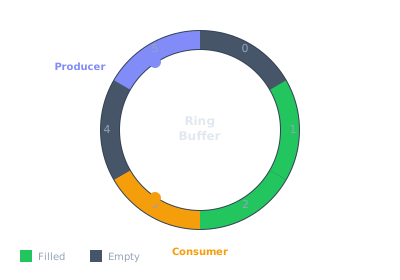
Ring buffer showing wrap-around behavior with producer and consumer indices
How It Works:
We maintain two indices:
- producer_index: Where the next item will be written
- consumer_index: Where the next item will be read
The Modulo Trick:
The key to implementing wrap-around is the modulo operator (%):
// Advance producer index
producer_index = (producer_index + 1) % buffer_size;

// Advance consumer index
consumer_index = (consumer_index + 1) % buffer_size;
How modulo causes wrap-around:
Let's say buffer_size = 5. Here's what happens as the producer advances:
- Index 0 → (0 + 1) % 5 = 1
- Index 1 → (1 + 1) % 5 = 2
- Index 2 → (2 + 1) % 5 = 3
- Index 3 → (3 + 1) % 5 = 4
- Index 4 → (4 + 1) % 5 = 0 ← Wraps back to start!
The modulo operator divides by buffer_size and returns the remainder, which is always
between 0 and buffer_size - 1.
Visual Example:
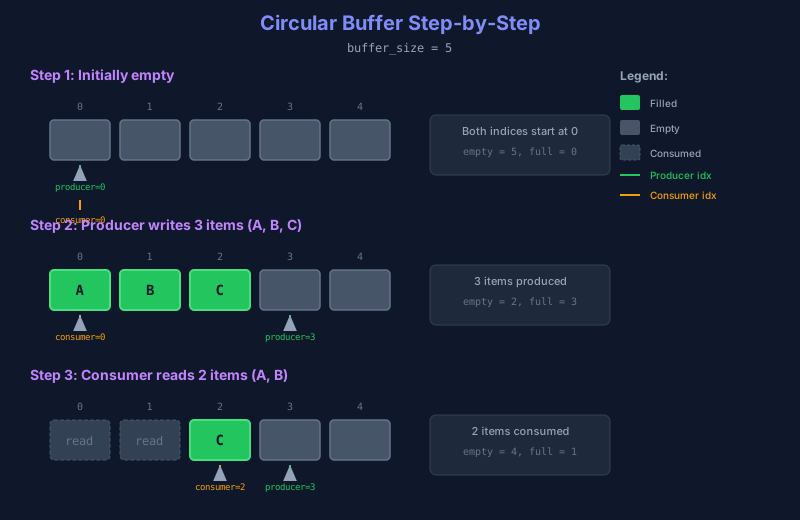
Why This Matters for IPC:
In shared memory, both the producer and consumer processes access this same buffer structure. The circular design means:
- No memory reallocation needed (fixed size works perfectly)
- Simple index arithmetic (just increment and modulo)
- Efficient memory reuse (old slots are overwritten after consumption)
1.5 Binary vs. Counting Semaphores
Semaphores come in two flavors, and understanding the difference is crucial for solving synchronization problems:
Binary Semaphore (Mutex):
A binary semaphore can only have two values: 0 or 1. It acts exactly like a lock:
- Value 1: The lock is available ("unlocked")
- Value 0: The lock is taken ("locked")
Use case: Protecting a critical section—a piece of code that only one process should execute at a time.
Real-world analogy: A bathroom with a single lock. Either it's unlocked (1 = vacant) or locked (0 = occupied). Only one person can use it at a time.
// Using binary semaphore as a mutex
P(mutex);           // Lock (wait if already locked)
// ... critical section ...
V(mutex);           // Unlock
Counting Semaphore:
A counting semaphore can have any non-negative integer value (0, 1, 2, 3, ...). It represents the count of available resources.
- Value N: There are N resources available
- Value 0: No resources available (processes must wait)
Use case: Tracking "how many" of something is available, like empty buffer slots or filled items.
Real-world analogy: A parking garage with 100 spaces. The semaphore value represents available spaces. Each car entering decrements it; each car leaving increments it. When it hits 0, incoming cars must wait.
In Our Solution:
mutexis binary (always 0 or 1)—it locks access to the bufferemptyis counting—tracks how many empty slots existfullis counting—tracks how many items are ready for consumption
Together, they orchestrate the dance: The counting semaphores ensure producers wait when full and consumers wait when empty, while the mutex ensures only one process modifies the buffer at any moment.
1.6 Virtual Memory and Address Spaces
Why This Matters for Shared Memory
When using shared memory between processes, you need to understand a key concept: processes don't share addresses, they share data. This might seem confusing at first, so let's break it down.
Virtual vs. Physical Memory
Modern operating systems use virtual memory—a layer of abstraction between your program and physical RAM:
- Each process has its own virtual address space starting at address 0
- The MMU (Memory Management Unit)—a hardware chip—translates virtual addresses to physical addresses
- The OS maintains page tables that tell the MMU how to do this translation
How Shared Memory Works
When two processes attach to the same shared memory segment, here's what happens:
- The OS maps the same physical memory region into both processes' virtual address spaces
- Each process gets a pointer to this shared memory—but the pointer values may be different!
- Despite having different addresses, both processes are reading and writing the same physical bytes
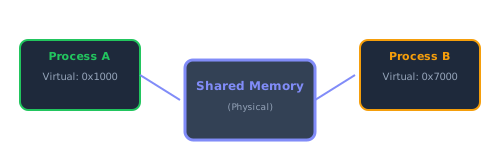
Both processes map the same physical memory region to different virtual addresses
Example:
// Process A (consumer)
void* addr = shmat(shmid, NULL, 0);
printf("My address: %p\n", addr);   // Prints: 0x7f1234000000

// Process B (producer)
void* addr = shmat(shmid, NULL, 0);
printf("My address: %p\n", addr);   // Prints: 0x7f9876000000  (DIFFERENT!)

// But both are accessing the SAME physical memory!
// If Process A writes 42, Process B will read 42.
Key Takeaway:
Never share pointers between processes! A pointer that's valid in Process A is meaningless garbage in Process B. Instead:
- Share data (integers, structs, arrays)
- Share indices into arrays (like
producer_index) - Each process uses its own pointer to access the shared data
Result: Both processes access the same physical data, even though their pointers show different values. The data is shared, not the address.
1.7 Connecting the Concepts
Before moving on, let's see how all these pieces fit together:
- IPC provides the mechanism for processes to communicate
- Shared memory is the communication channel (the buffer)
- Semaphores ensure safe, coordinated access to the buffer
- The circular buffer efficiently reuses fixed memory
- Virtual memory explains how two processes can access the same data
In the next sections, we'll dive deep into the actual System V API calls that implement shared memory and semaphores.